Microfreak/UG/05 Connections/01 Control Signals
05.1 Control Signals
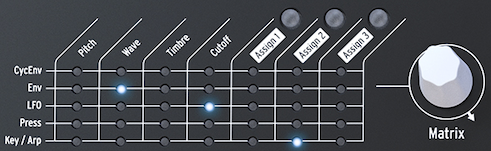
- The Matrix connects control signals from the MicroFreak's modules. These signals move more slowly than audio and are suited to controlling sound.
- The MicroFreak Matrix
- Control signals usually move between 0 and 100 Hz. They can modulate the Digital Oscillator, Analog Filter, and other destinations. The Matrix encoder sets their amount from -100% to +100%.
- The MicroFreak's modules generate control signals in different ways.
- The LFO makes slow, regular waves. Routed to oscillator pitch, it makes the pitch rise and fall; it can reach 100 Hz.
- An envelope rises once, then gradually fades. Routed to oscillator pitch, it creates a quick rise followed by a descent. The Cycling Envelope can repeat, acting as a second LFO with more complex modulation waves.
- A gate rises at Note On and falls at Note Off. The keyboard sends gates that start the MicroFreak's envelope.
- Three kinds of control signals are used: triggers, gates, and waves.
- Triggers are very short spikes that start an envelope, LFO, or sequencer. Clocks generate triggers.
- Gates last longer and keep something active, such as an envelope's hold stage. A keyboard sends a gate while a key is held.
- Waves can last any length and usually cycle from high to low and back. The MicroFreak's LFO and two envelopes create slow waves.
- Control signals give a MicroFreak performer room to develop a personal style, as color and line do for a painter.
- Note for advanced users: Analog synthesizers and modular systems use control voltages for modulation. Mostly digital synthesizers such as the MicroFreak use digital signals that mimic those voltages; this manual calls them control signals.