Microfreak/Meta/Structure
Ghost Gardener Project - Turn the Microfreak namespace in a logseq translation of the docs pdf - 2026-09-25 Fri
- I'd like to try something relatively new. I have
~/Downloads/microfreak_Manual_5_0_1_EN.pdf, which is the latest version of the documentation for the arturia microfreak. I'd like to have this determine the structure of the Microfreak namespace in logseq that you should fill out. - I don't want the PDF to be imported into logseq assets. That just adds binary weight to the whole repo. Instead, AI should pull the text and images out into the logseq pages, mirroring the heading structure in logseq namespaces and following my preferences below.
- So, for example, take a look at these pages, which I manually converted to match my needs.
my preferences
high level conversion principles
- Translate what the source is communicating to a logseq-native representation.
- We're not aiming at zero information loss or absolute fidelity to the original. My preference is to have a logseq-native representation that is easy to read and idiomatic inside of logseq.
- use page embeds and avoid block embeds. Text should not be repeated.
two digit zero padded numbers
- to preserve Lexicographic/Order
use logseq links in place of page references or PDF links and adjust the text around it so it makes sense when read
- Example
- The ear can perceive sound around 50 Hz as bass (think huge organ pipes), but around 30 Hz it's difficult for the ear to hear a sound as a pitch; it's perceived as a low rumble. In electronic music, low-frequency sounds are often used as voltage or control signals to modulate another module. An LFO is an oscillator specifically designed to generate frequencies in this range. The LFO in the MicroFreak can generate signals in the range from 0.1Hz to 100Hz. Please refer to Microfreak/UG/08 LFO for details.
- This appears on page 36, which originally had
- I replaced the last sentence with
Please refer to Microfreak/UG/08 LFO for details.
- So that the sentence is truly translated to Logseq properly.
- The ear can perceive sound around 50 Hz as bass (think huge organ pipes), but around 30 Hz it's difficult for the ear to hear a sound as a pitch; it's perceived as a low rumble. In electronic music, low-frequency sounds are often used as voltage or control signals to modulate another module. An LFO is an oscillator specifically designed to generate frequencies in this range. The LFO in the MicroFreak can generate signals in the range from 0.1Hz to 100Hz. Please refer to Microfreak/UG/08 LFO for details.
- Example
place referenced images in logseq assets according to my sequential preferences for the filename and place the image underneath the caption
- Example
- Here, the original had this image with the caption
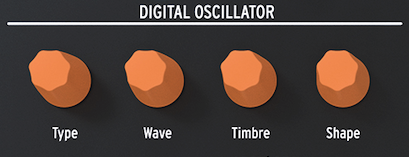
The Digital Oscillatorbelow it in the PDF. I created the image../assets/Microfreak___UG___06-Dig-Osc___01-as-Soundgen___01-The-Digital-Oscillator.pngand referenced it withso it would appear correctly in logseq and the caption would become the alt text of the image. I also moved the image underneath its caption in logseq. - I also numbered the image within the section, so that as long as the image filepath is derived from the logseq page that the image was used in, if I look at the assets directory, all of the images in the PDF would be sorted in order of their appearance in the text, when sorted in Lexicographic/Order.
- Here, the original had this image with the caption
- Example
intelligently translate tables to nested logseq markdown while preserving communicative purpose and respecting the need for concision
- so that it can be opened in nvim easier. Clean up tables when converting them to logseq format by translating their communicative value into logseq hierarchy of nodes. That is, intelligently omit column names where they don't add communicative value; many times the actual purpose of the table is to convey information that should be hierarchical anyway. There's not a hard and fast rule here; just try to make it seem natural in logseq.
- Examples
- from Microfreak/UG/18 Appendix A Speech Osc, labeled page 125, pdf page 130
- from Microfreak/UG/19 Appendix B Vocoder/07 Config, labeled page 133 in the PDF (pdf page number 138)
- from Microfreak/UG/20 Appendix C - Cheat Sheet labeled p139, pdf p144
- from Microfreak/UG/21 Appendix D - CC Values, labeled page 141, pdf page 146
use logseq bullet points for bullets
- model the bullet, don't put the bullet as text, e.g. don't use • as it's redundant
- Example
- from Microfreak/UG/19 Appendix B Vocoder/07 Config/01 Preset Settings labeled page 133 (pdf page 138)
entities to define
- It's my hope that you can define these entities such that any AI familiar with the entity system can convert any PDF sufficiently similar to thie particular PDF to this type of structure, matching my preferences, without needing a specific logseq skill.
- Logseq/Entity/Book/Section - General, shared characteristics shared pages that model all section types
- Logseq/Entity/Book/Section/Level 1
- Logseq/Entity/Book/Section/Level 2 - same but for level 2
- Logseq/Entity/Book/Section/Level 3 - same but for level 3
- Logseq/Entity/Book/Section/Level 4 - same but for level 4
- I didn't create an example of nesting inside a level two section, but I think you'll get the point.
Suggested order of operations
- Commit these instructions
- File a github parent issue for this task, with sequenced github child issues for:
- Prototype book section entities
- Convert a few pages or sections that represent my preferences
- Store scripts in a sensible place in the repo, following my preferences
- I do not expect a full scripted conversion to meet my preferences, however, I'm expecting that a single skill:
logseq-entity, combined with entity definitions and access to scripts referenced in the entity definitions, should be sufficient for the conversion - After conversion, evaluate them against my preferences, update as necessary
- Convert a few pages or sections that represent my preferences
- Harden logseq-entity skill import of section
- Test the conversion of a section using nothing but logseq entity skill using a fresh context uninformed by the rest of the work. Use a subagent with a CLI tool in tmux, for example, Codex/CLI, GitHub/CoPilot/CLI, CursorAI/CLI, Claude/Code/CLI with appropriate auto mode settings, and as it "Please import logseq section entities from
<path to pdf>for<reference to section>" - Update the text of Logseq/Entity/Book/Section and other entities, the scripts referenced in those entities.
- There's a very small chance you may find yourself wanting to update the Rulesync/Skill/logseq-entity skill itself. I would prefer that you didn't. This is my single most important skill, and it has a wide blast radius in terms of how it operates. I aim to keep this small and compact. I will only support that if you explain to me how your change improves the entire entity system and it's not specific to this task and how that update won't degrade its performance on other entities. Think of this skill as the "linux kernel" of how I use AI with Logseq.
- Iterate until using any harness with the
logseq-entityskill produces results that are in line with my preferences
- Test the conversion of a section using nothing but logseq entity skill using a fresh context uninformed by the rest of the work. Use a subagent with a CLI tool in tmux, for example, Codex/CLI, GitHub/CoPilot/CLI, CursorAI/CLI, Claude/Code/CLI with appropriate auto mode settings, and as it "Please import logseq section entities from
- Import each section (create an issue for each)
- Prototype book section entities
Requests and Rules
- standard request - agents should familiar with titles of files in My namespace and contents of selected files in My/AI/Rule namespace, My/Pref, My/Principle and other namespaces you deem to be relevant to this task.
- agents should work in a worktree and submit PRs; My/Pref/Dev/Tool/git/Worktree.
- agents should mark github issue as in progress in some consistent way if that's not too much trouble. the purpose of this is to help me see the progress of the project. you don't have access to github projects likely, so don't ask.
- Each github issue should be one context window of an agent. Plan accordingly. I don't want agents using a large amount of context or solving more than one issue.
- Your assignment has been adequately described in this document. Don't bother me too much with clarifications. I will only evaluate your output when I deem you to have iterated sufficiently on this problem yourself.
- My target for this goal is to converge by 2026-09-27 Sun.
- I'm going to try not editing the pages under Microfreak until you are done.
- PRs can stack up. You are not blocked by me not merging.
- I'd like to try something relatively new. I have