Making/Music/Log/26/11/02-Mon
Properties
- 2026-11-02 Mon
02:35 — Notes on the November 1 session
- About GitP/A/Session/26/11/01-Sun.
Template changes and a recording mix-up
Transcription
- The 2026-10-31 entry on the upper half of this page is on Making/Music/Log/26/10/31-Sat.
- 2026-11-02 Mon 0235
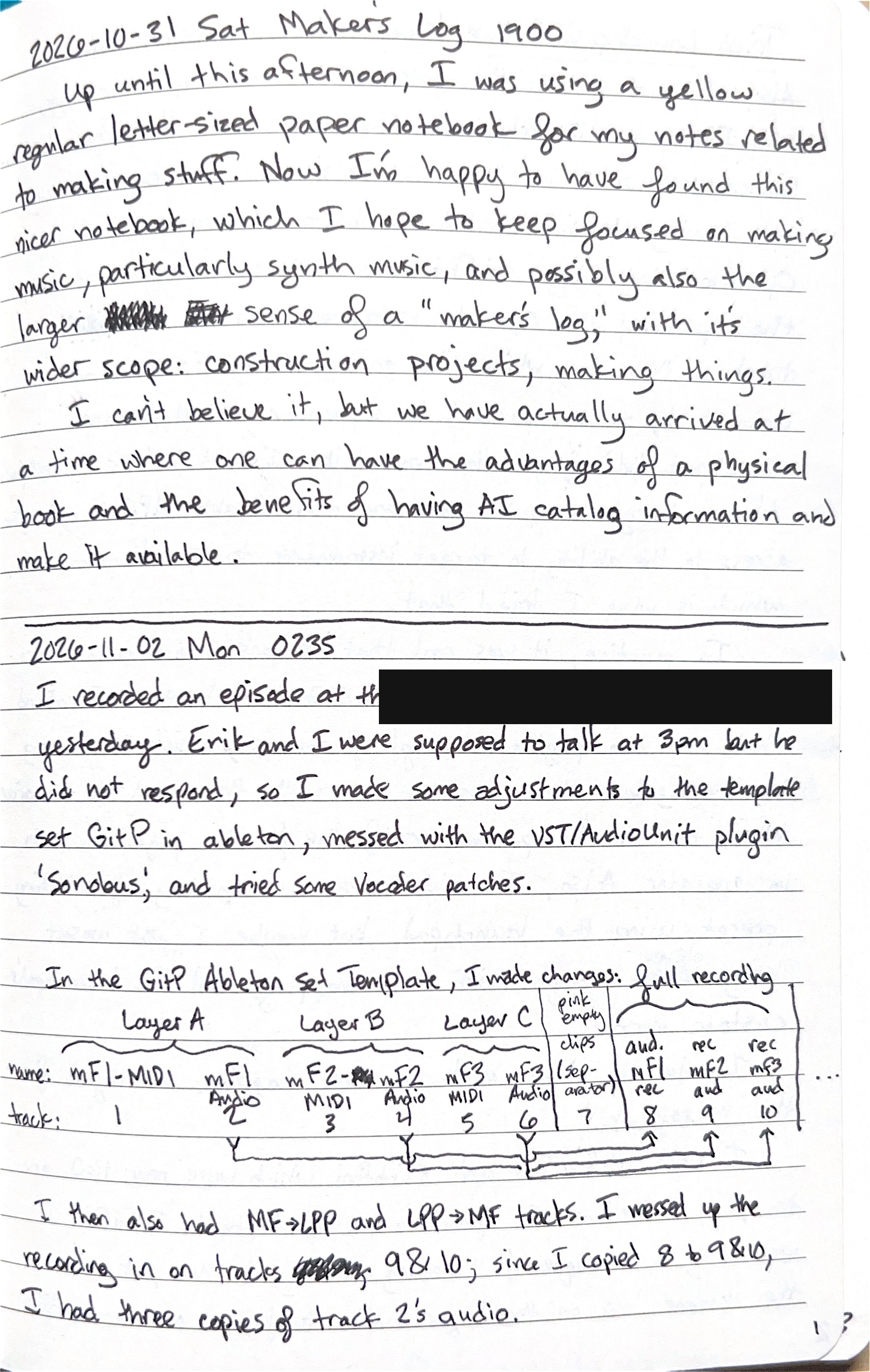
- I recorded an episode at [location blacked out in the image] yesterday. Erik and I were supposed to talk at 3pm but he did not respond, so I made some adjustments to the template set GitP in ableton, messed with the VST/AudioUnit plugin 'Sonobus', and tried some Vocoder patches.
- In the GitP Ableton Set Template, I made changes:
- I then also had MF→LPP and LPP→MF tracks. I messed up the recording in on tracks 9 & 10; since I copied 8 to 9 & 10, I had three copies of track 2's audio.
Diagram
AI notes (Anthropic/Model/Claude/5/5/Opus)
- The GitP/A/Template now has three MicroFreak layers, each a MIDI and an audio track, then a separator and three tracks that record each layer's audio.
- Tracks 9 and 10 were copies of track 8 and kept its input, so all three recorded Layer A. This is why only Layer A was fully recorded, as noted on Making/Music/Log/26/11/01-Sun.
- The plugin name reads 'Sonobus'; it is probably SonoBus, a peer-to-peer audio streaming plugin.
Launchpad to Operator and the three MicroFreak layers
Transcription
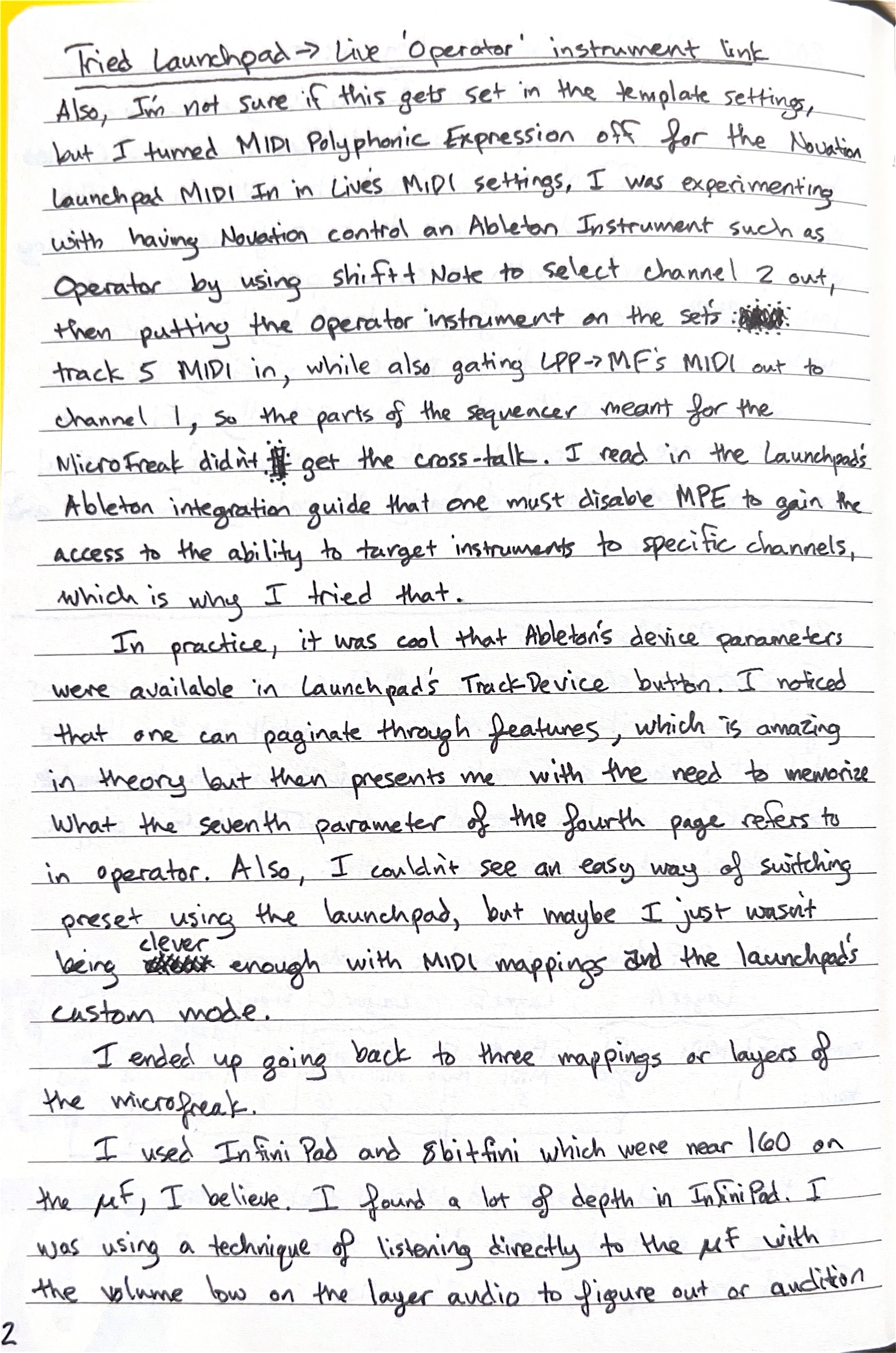
- Tried Launchpad → Live 'Operator' instrument link
- Also, I'm not sure if this gets set in the template settings, but I turned MIDI Polyphonic Expression off for the Novation Launchpad MIDI In in Live's MIDI settings. I was experimenting with having Novation control an Ableton Instrument such as Operator by using shift + Note to select channel 2 out, then putting the Operator instrument on the set's track 5 MIDI in, while also gating LPP→MF's MIDI out to channel 1, so the parts of the sequencer meant for the MicroFreak didn't get the cross-talk. I read in the Launchpad's Ableton integration guide that one must disable MPE to gain the access to the ability to target instruments to specific channels, which is why I tried that.
- In practice, it was cool that Ableton's device parameters were available in Launchpad's Track Device button. I noticed that one can paginate through features, which is amazing in theory but then presents me with the need to memorize what the seventh parameter of the fourth page refers to in operator. Also, I couldn't see an easy way of switching preset using the launchpad, but maybe I just wasn't being clever enough with MIDI mappings and the launchpad's custom mode.
- I ended up going back to three mappings or layers of the microfreak.
- I used Infini Pad and 8bitfini which were near 160 on the μF, I believe. I found a lot of depth in Infini Pad. I was using a technique of listening directly to the μF with the volume low on the layer audio to figure out or audition
AI notes (Anthropic/Model/Claude/5/5/Opus)
- To play Ableton/Live/UG/31 Instrument Reference/09 Operator from the Novation/Launchpad/Pro/Mk3 alongside the MicroFreak: turn off MPE for the Launchpad's MIDI input (Ableton/Live/UG/12 Editing MPE), send the Launchpad on channel 2 to Operator, and limit the MicroFreak routing track to channel 1.
- The Launchpad's Device mode exposes Operator's parameters in pages, which works but means memorising what each slot does. Preset switching from the Launchpad was not found.
- The session went back to three MicroFreak layers with Microfreak/Preset/259 Infini Pad and Microfreak/Preset/260 8bitfi (written "8bitfini").
Selecting MicroFreak presets from the Launchpad
Transcription
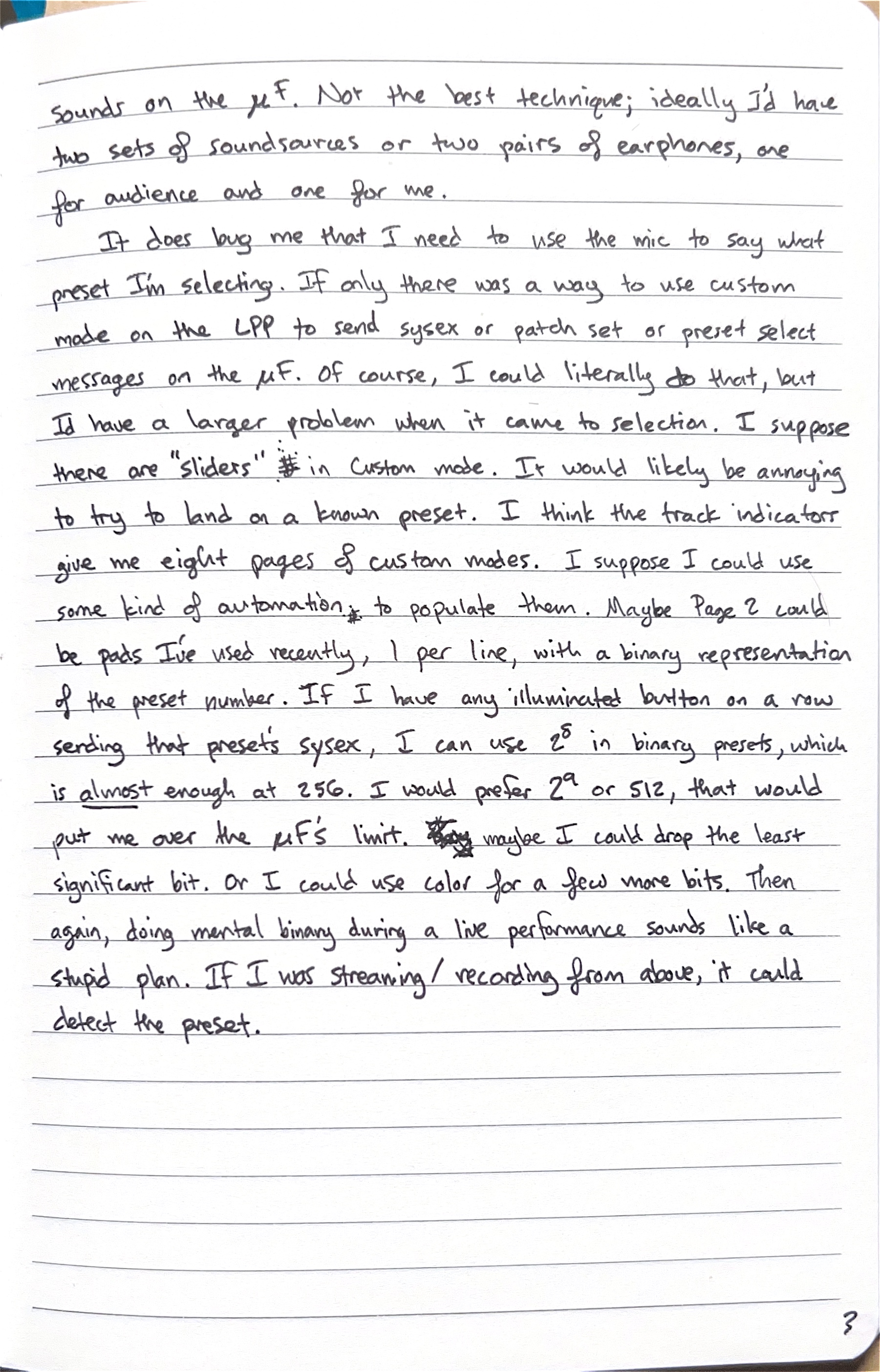
- sounds on the μF. Not the best technique; ideally I'd have two sets of soundsources or two pairs of earphones, one for audience and one for me.
- It does bug me that I need to use the mic to say what preset I'm selecting. If only there was a way to use custom mode on the LPP to send sysex or patch set or preset select messages on the μF. Of course, I could literally do that, but I'd have a larger problem when it came to selection. I suppose there are "sliders" in Custom mode. It would likely be annoying to try to land on a known preset. I think the track indicators give me eight pages of custom modes. I suppose I could use some kind of automation to populate them. Maybe Page 2 could be pads I've used recently, 1 per line, with a binary representation of the preset number. If I have any illuminated button on a row sending that preset's sysex, I can use 2⁸ in binary presets, which is almost enough at 256. I would prefer 2⁹ or 512, that would put me over the μF's limit. maybe I could drop the least significant bit. Or I could use color for a few more bits. Then again, doing mental binary during a live performance sounds like a stupid plan. If I was streaming / recording from above, it could detect the preset.
AI notes (Anthropic/Model/Claude/5/5/Opus)
- Auditioning on the MicroFreak while the audience hears the layer mix needs separate monitoring: two sound sources or two pairs of earphones. This matches the open question in Zoom H5/Q/How can I record the line out on a MacBook or iPhone while monitoring on the headphone jack?.
- Saying the preset name into the mic is a workaround. A Launchpad custom mode could send preset-change messages, with a page of recent presets shown as lit pads encoding the preset number in binary. Eight pads give 256 values; nine would cover all 512 MicroFreak slots (Microfreak/UG/01 Welcome and Introduction/02 New in FW 5.0.0).
- Binary under performance pressure is impractical. An overhead camera reading the MicroFreak's display could log the preset instead.
Improving the episode format of Ghost in the Patch Alpha Sessions
- This morning I was looking at GitP/A/Session/26/11/01-Sun, which AI drafted from the ableton live set folder as well as some notes I took in Making/Music/Log/26/11/01-Sun.
How can we improve Logseq/Entity/Podcast/Episode/GitP/A and related entity definitions? My Notes and Ghost Gardener requests in todos
- I'd like to update the GitPA episode entity definition and related entity definitions so it better meets my needs and the needs of the ceremonial participants.
Partis, not Listeners
- Less than half joking, I'm actually thinking of these listener stakeholders as "Participants" or Partis for short, as in time, I want this to move from a podcast into more of a bidirectional communion, where they respond with sounds as well.
- define GitP/Participant term entity with an alias of
Ghost in the Patch ParticipantorPartisin plural for short, explaining briefly why I consider my podcast listeners to be participants
- define GitP/Participant term entity with an alias of
- Less than half joking, I'm actually thinking of these listener stakeholders as "Participants" or Partis for short, as in time, I want this to move from a podcast into more of a bidirectional communion, where they respond with sounds as well.
Let's make episode pages more oriented toward Partis and their needs
- My/Principle and sub-namespaces should influence this design, particularly My/Principle/Simplify and My/Principle/Simplify/Don't Repeat Yourself DRY.
Better Ceremony Notes
- The intro section is used for the show notes on the RSS, and it's the first thing that participants see on the website or in their podcatcher. It should be inviting, weird, and curious, with no needless AI "flange," by which I mean, useless tidbits of information that don't serve the purpose of the ceremony and its effects on its participants.
- define a term entity for Podcast/Catcher with an alias of Podcatcher in logseq
- the first thing in the episode page should be the play button for the session.
- make an H2 section definition,
Ceremonial Annotationswhich should be the equivalent of the official episode notes.define the "vibe" or rhetoric of Ceremonial Annotations in GitP/Vibe
- religious short wave AM radio show notes.
- I want to get back to that feeling I had as a kid where I built a short wave radio and tuned into stuff from across the world in the middle of the night.
- I also want to get back to that seance-adjacent religious vibe I witnessed / was a part of a few times throughout my youth. Whether it's Christian Communion, Tibetan Dzogchen, or Carlos Castaneda power stalking at night with Djembes, I need more spirit life spark.
- adjacent to steampunk in a way that's not commoditized for mass consumption.
- More of this Person/Jules Verne,
- While there's a spot in my heart for Person/Joss Whedon and Person/Robert Zemeckis, their mass market appeal is definitively what I'm avoiding here
- practical, respectful, technical performance notes for fellow performers
- musicological musings
- whimsical pseudo-cryptic poetic and animistic reflections
- religious short wave AM radio show notes.
- The intro section is used for the show notes on the RSS, and it's the first thing that participants see on the website or in their podcatcher. It should be inviting, weird, and curious, with no needless AI "flange," by which I mean, useless tidbits of information that don't serve the purpose of the ceremony and its effects on its participants.
Tranform
Recording and Prepsection- The purpose of this section should be for ceremonial participants and technical practitioners (read: musicians) to dig into the details of what happened and figure out how certain sounds were evoked from the spirits. This section should be archival in nature.
- Right now, it has a
Recording and Prepsection. Make some updates to the entity definition about this.- Instead of
Recording and Prep, GitP episodes should have an h2 sectionCeremonial Artifacts. It should have nested h3 headingsRecording - ensure the entity definition indicates that this should be collapsed by default, as it's unnecessary information for most viewers.
- this section should be at the bottom, as it's the last thing listeners are likely to be interested in.
- Instead of
transform Chapters
- similar to GitP/A/Session/26/10/29-Thu chapters, in general we should assume that the H3 beneath Chapters should be about a single preset, named similar to 00:00 enter Microfreak/Preset/016 Voidom,
00:00 enter <reference to Microfreak preset>. The bullets that are nested within that should be "about" that preset. Within that preset, should also be timestamps that are clickable in the web version of the site that will take one to playing that portion. This should go to arbitrary depth. Anywhere there is a bullet that starts withMM:SSfor example04:12, it should be clickable and go to that point. This way there should be chapters and sub-chapters. - take a look at how I annotated 00:00 enter Microfreak/Preset/016 Voidom - that's hand-annotated from me, and I expect it to be more like this when AI does it. In general, if I put it, I'd like it to be in a My Notes attribution, and if GitP/Acolyte "says" it (an AI personality and virtual co-host), it should be attributed to GitP/Acolyte. Don't use block quotes.
- similar to GitP/A/Session/26/10/29-Thu chapters, in general we should assume that the H3 beneath Chapters should be about a single preset, named similar to 00:00 enter Microfreak/Preset/016 Voidom,
Overall Comments
- Right now, MIDI has many issues with it.
- make a note in My/Pref/Markdown that in my preferences for logseq and obsidian flavored wiki markdown we should, never, ever mix traditional markdown formatting and wiki formatting. This section currently has, this terrible way of using markdown hyperlink syntax to reference a wikilink destination which is not readable in the plain text representation and is needlessly complicated. Also, make a note in the gitpa episode definition to reference GitP/Vibe as the writing style - our participants don't need, want or benefit from CC annotations. That's not ceremonial! That said, saying "no oscillator-type changes" is a useful note, though it would be better as a microfreak hyperlink in logseq.
- Right now, MIDI has many issues with it.
please model ableton live set as a logseq entity definition
- I would like
<episode>/Set/Track/<group or track name>/<track name>to be created for each track with an entity description. ThenSetshould be a page of Logseq/Entity/Ableton/Set should be an entity definition along with Logseq/Entity/Ableton/Track/Group and Logseq/Entity/Ableton/Track/Track which, like the relationship between Logseq/Entity/Book/Section/Level 1 and its siblings, includes transclusions. The purpose of these entities is
- I would like
Let's prototype a Logseq/Entity/Podcast/Episode/GitP/A/Layer definition
- Most episodes lately have had three layers of live-looping recordings. Usually there's three tracks for incoming audio from the microfreak accompanied by adjacent three tracks for incoming midi from the microfreak, forming layer A (midi, audio), layer B (midi, audio), layer C (midi, audio). Create a layer definition which assumes that under a gitpa episode namespace
<namespace>/Layer/{A,B,C}/{Audio,MIDI}can be used to reference these components. It can indicate which<episode namespace>/Set/Trackmodels it. - I'm just trying to create a standard nomenclature for referencing parts of the performance.
- Most episodes lately have had three layers of live-looping recordings. Usually there's three tracks for incoming audio from the microfreak accompanied by adjacent three tracks for incoming midi from the microfreak, forming layer A (midi, audio), layer B (midi, audio), layer C (midi, audio). Create a layer definition which assumes that under a gitpa episode namespace