Ableton/Live/UG/29 Audio Effect Reference/32 Reverb
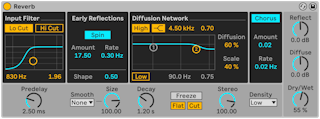
- Reverb imitates sound echoing in a space. Real reverb comes from reflections off hard surfaces, shaped by absorbent materials; Reverb approximates it with filters and modulated delays, for anything from a small room to a canyon.
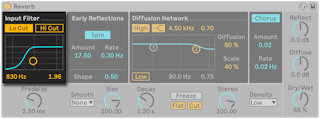
- Low and high cut filters come first. An X-Y controller sets the band's center (X) and width (Y), also available as sliders. Either filter can be turned off to save CPU.
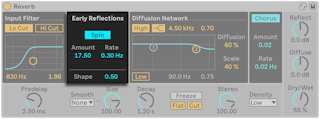
- Early reflections are the first echoes off the walls before the diffuse tail; their level and spacing suggest the room's character.
- Spin modulates them; Amount and Rate set it. More Amount gives a more neutral tail. Too high a Rate causes Doppler pitch shifts and odd panning. Turning Spin off saves some CPU.
- Shape — low values: reflections fade slowly and overlap the tail, for a smoother decay; high values: they fade fast and the tail starts later, which can help clarity.
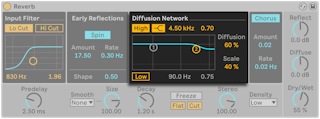
- The Diffusion Network makes the tail after the early reflections.
- High and low shelf filters make decay depend on frequency. The high shelf models absorption by air, walls, people and carpet; the low shelf thins the decay. Either can be turned off to save CPU.
- Diffusion and Scale set density and coarseness; in very small rooms they strongly color the sound.
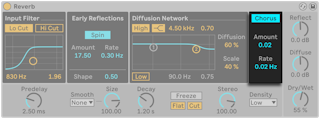
- Adds a little movement to the tail, with Amount and Rate, or switch it off.
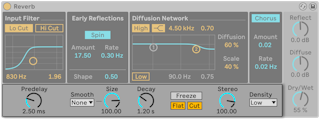
- Predelay — ms before the first early reflection; affects perceived room size. Natural values are about 1–25 ms.
- Smooth — how Size changes take effect: None jumps (may cause artifacts), Slow or Fast glide.
- Size — room volume; very large gives a shifting, diffuse delay, very small a colored, metallic sound
- Decay — time for the tail to fall by 60 dB
- Freeze — holds the diffuse sound almost forever.
- Flat — bypasses the shelf filters while frozen, so the frozen sound does not lose energy in those bands
- Cut — stops new input adding to the frozen sound
- Stereo — width, from mono up to 120°, where each ear gets an independent tail
- Density — quality versus CPU, from Sparse to High
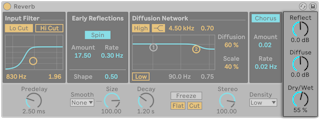
- Reflect and Diffuse set the levels of the early reflections and the tail; Dry/Wet sets the overall mix.