Ableton/Live/UG/29 Audio Effect Reference/01 Amp
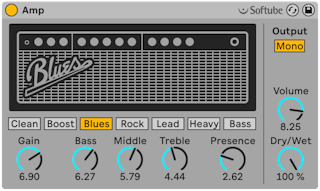
- Amp models seven classic guitar amplifiers, built with Softube using physical modeling. Every model uses the same controls.
- Models:
- Clean — the "Brilliant" channel of a 1960s amp associated with the British Invasion
- Boost — the "Tremolo" channel of the same amp; edgy rock riffs
- Blues — a bright 1970s amp popular in country, rock and blues
- Rock — a classic 45-watt 1960s amp
- Lead — the "Modern" channel of a high-gain metal amp
- Heavy — the "Vintage" channel of that amp; metal and grunge
- Bass — a rare 1970s PA with strong lows and fuzz at high volume
- Gain drives the preamp and is the main distortion control. Volume sets the power amp stage; on Blues, Heavy and Bass, high Volume adds distortion too.
- Bass, Middle and Treble shape the tone. As on real amps they interact with each other and with the rest of the amp in non-linear ways; raising EQ can add distortion.
- Presence — extra mid/high tone control in the power amp stage, adding or removing edge; its effect varies by model
- Output — mono or stereo (Dual); Dual uses twice the CPU
- Dry/Wet — balance of processed and dry signal
- Amp behaves like analog hardware, so results are not always predictable.
- An amp's circuits share a fixed amount of power, so raising one control can take energy from another. Turning up Treble can reduce bass and mids, so getting a sound may mean adjusting controls that seem unrelated.