AI/ES/25/11 Code/LEAD/20 Thu/0925 Michele Catasta VP Replit Autonomy is all you need
9:25am - 9:44am Talk: Autonomy Is All You Need

- Person/Michele Catasta Twitter LinkedIn GitHub - VP of AI, Replit
Talk: Autonomy Is All You Need 00:31:36 - Replit (Michele Catasta): Supervised vs. Unsupervised Autonomy for Non-Technical Users
- AI agents exhibit vastly different degrees of autonomy. Yet, the ability to accomplish objectives without supervision is the critical north star for agent progress, especially in software creation. For non-technical users who cannot supervise software creation, full autonomy is essential, not optional.
- First of all, I will discuss two foundational capabilities to achieve true autonomy: automatic testing to verify correctness without human validation, and advanced context management to maintain coherence across complex, long-horizon tasks.
- With autonomy established, parallelization becomes the key to delivering a compelling user experience. Sequential execution forces users to wait extensively before seeing progress, breaking the development flow. This talk explores parallelization models (task-level parallelism, out-of-order execution, plan decomposition, etc.) and their tradeoffs in latency, resource consumption, and correctness guarantees.
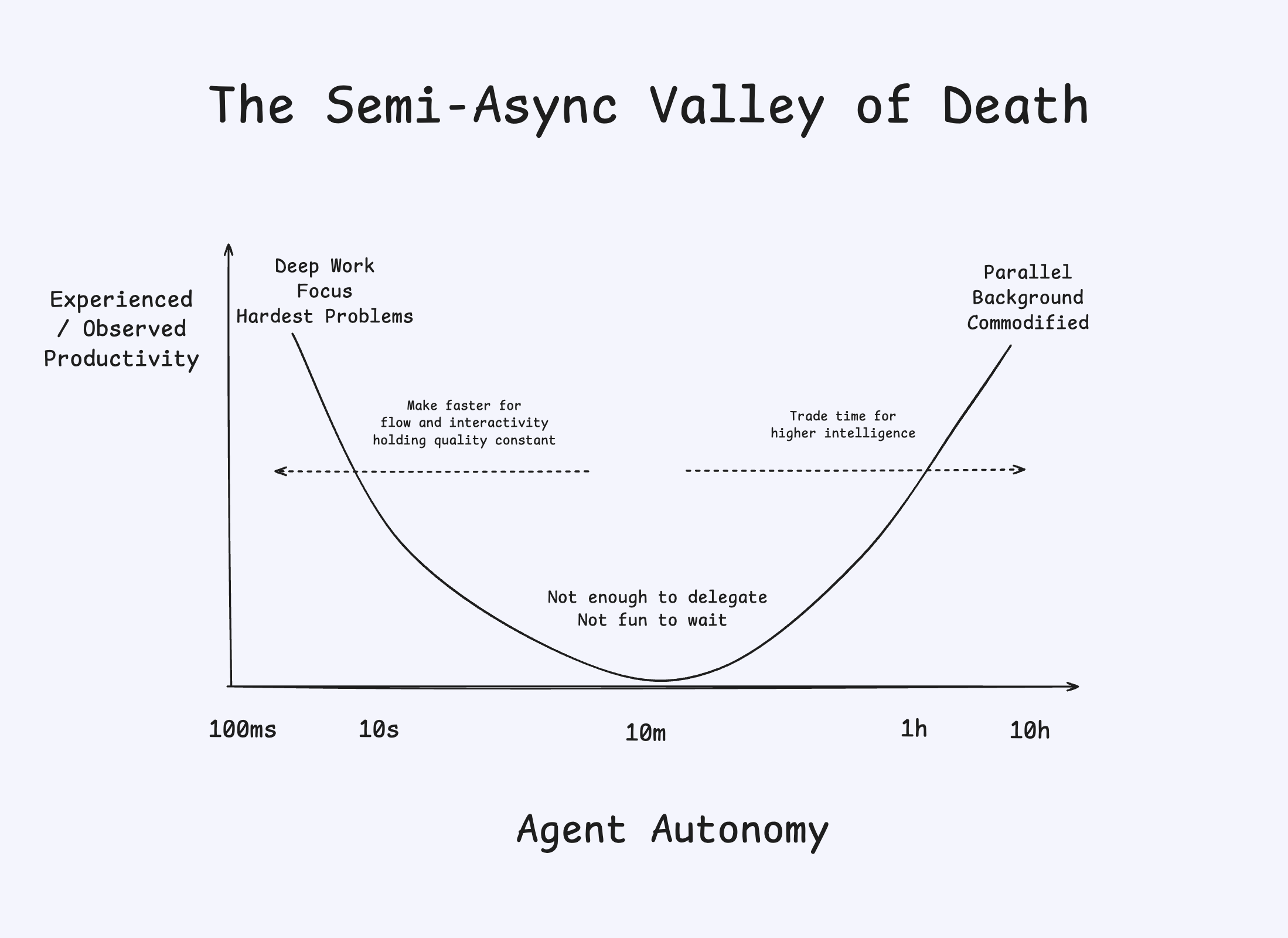
Semi-Async Valley of Death
From Copilots to Autonomous Agents
- <1 minute feedback loop, constant supervision
- Completions → Assistant → v1 ReAct → v2 Tool Calling → v3 Autonomous Agents → Hours of independent work
- Code completion / assistant require deep technical expertise
- v1/v2 Agents were not sufficiently autonomous for wide adoption by knowledge workers ("valley of death")
- Can we build fully autonomous Agents?
Scoped Autonomy
- Autonomy is conflated with long run-times or loss of control
- Autonomy can be given a very specific scope
- Replit Agent 3 makes technical decisions autonomously
- Long gaps if the scope is broad → no constant check-ins needed
- Agents can be autonomous and fast on a narrow scope
- The user maintains control over project aspects that matter to them
Autonomy is not a vanity metric
- Tasks have irreducible complexity
- Agents plan → implement → test → loop
- Goal: maximize irreducible runtime
- At Replit:
- Users are nontechnical
- Agent must be trusted collaborator
- Abstract away software-creation pain
- Users control project but trust Agent with technical decisions
Pillars of Autonomy
- Frontier capabilities: baseline IQ
- Verification: local correctness, 9s reliability, avoid compounding errors
- Context Management: global coherence, goal + task management
- Result: multi-hour autonomous work
Verification - First Pillar
- Testing fixes broken and hallucinated features
- Mock data, no DB; button handlers not wired
- Without tests, Agents build “painted doors”
- My Note I like this term: Painted Door
- 30%+ of features are broken
- Nearly every app has at least one broken or fake feature
- Feedback without Human Supervision
- Agents must gather their own feedback
- Non-technical users can’t give technical feedback
- They can only do tedious QA (bad UX)
- Why autonomous testing?
- Break the feedback bottleneck
- Prevent small errors from accumulating
- Overcome frontier-model laziness by verifying completions
- Spectrum of Code Verification
- Supervised Agents:
- LSP + execution: basic correctness
- Unit tests: functional correctness
- API tests: end-to-end API, user-like consumption
- Autonomous Agents:
- Browser use: simulate UI
- Computer use: full UI, screenshots
- Fast/cheap code interaction → slow/expensive user interaction
- Autonomous App Testing
- Computer-use testing: screenshots ↔ actions
- Browser-use testing: DOM ↔ actions
- API testing: API calls ↔ app
- Replit Agent 3:
- Builds testable apps
- Merges feedback from multiple sources
- Uses computer-use only as fallback
- Tools vs Code for Browser Use
- Tool-based: agent issues clicks, fills, drags; hard to enumerate actions
- Agent 3: generates Playwright code
- Models can write it directly
- More expressive, higher coverage, more efficient
Context Management and Coherent Trajectories
- Long-context models not required for long, coherent agent runs
- Most tasks fit well within ~200k tokens
- The codebase becomes the memory
- It stores evolving state, plans, and task lists directly in files
- Agents persist context to disk before clearing internal memory
- Externalizes working memory into artifacts the agent can reread
- Anthropic quote:
- Claude Sonnet 4.5 maintains focus for 30+ hours on complex, multi-step software tasks
- Demonstrates long-trajectory stability without relying solely on massive context windows
Context Management with Subagents
- Subagents run as isolated workers: each receives a fresh context and a single task from the core loop
- Keeps their reasoning self-contained and ephemeral
- This separation of concerns prevents the core agent from polluting its own context window with temporary details
- Core agent stays lean; subagents handle messy, localized reasoning
- Result: more memories per compression cycle
- The line chart (before vs. after) shows a jump from low-30s memory retention to low-40s, a steady uplift after introducing subagents
Testing as a Subagent
- The slide shows a vertical stack: Agent Loop → Browser Action → Observation → Browser Action → Observation → … → Agent Loop
- Every browser step and observation gets appended into the main loop's context
- This traditional setup floods the core agent's context with low-level UI noise
- Leads to context pollution
- Consequences:
- Higher cost (more tokens)
- Slower execution
- Worse long-horizon performance
Testing as a Subagent (Agent 3 redesign)
- The slide contrasts the traditional stack (agent ↔ browser ↔ observation, repeated) with the Agent 3 architecture, which inserts a Verification subagent between two clean agent-loop states.
- Instead of dumping every click/DOM event into the main context, Agent 3 delegates all low-level UI work to a separate verification worker.
- That worker runs a tight loop: Playwright → Observation → Playwright → Observation, entirely outside the core agent's memory stream.
- The dashed lines show the core agent "outsourcing" this noisy interaction to the subagent; the results are summarized, not streamed in raw.
- This design protects the core loop from context bloat, improves coherence across long trajectories, and keeps the main agent focused on reasoning rather than UI chatter.
Parallelism
Trading compute for time with parallel agents
- Running agents in parallel burns extra compute but buys speed.
- Each parallel worker must reconstruct the same context in its own window.
- "agents are sharing 80% of the context across the board"
- Their outputs introduce merge conflicts that must be resolved.
- But this unlocks capabilities that would be too slow sequentially:
- Continuous testing and ongoing code review in the background
- Async processes feeding new information into the main agent's memory
- Sampling many possible trajectories to pick the best path
Background Agents (User as Orchestrator)
- The user manually decides which tasks to run, and each task is spun off in its own thread.
- Dispatch:
- A human expert decomposes tasks for the parallel agents.
- This decomposition is usually sub-optimal because it depends on human intuition.
- Merge:
- A human resolves merge conflicts after the parallel agents finish.
- Automatic merge-conflict resolution remains an unsolved general problem.
- Visual layout:
- Human → Orchestrator → (LLM Call 1 / 2 / 3) running in parallel → Human Synthesizer → Output.
- The user plays both dispatcher and merger, acting as the glue between parallel agent threads.
Subagents (Core Loop as Orchestrator)
- Here, the agent itself becomes the dispatcher.
- The core loop identifies sub-tasks as it reasons, based on its understanding of the problem and its own abilities.
- Dispatch:
- The core loop spends tokens to analyze, break down, and launch tasks to subagents.
- Decisions about parallelism happen dynamically, not predetermined by a human.
- Merge:
- Because the core loop chooses how to decompose tasks, merges become easier—the tasks were created with "merge-conflict awareness" baked in.
- Subagents can be specialized
- Different models, prompts, personas, or even different tool capabilities.
- Diagram structure:
- Core Loop Orchestrator → LLM Call 1/2/3 (Subagents) → Core Loop Synthesizer → Output
- The "glue" is now inside the agent rather than the human.