AI/Behavior/Tree
Behavior Trees Conceptual Overview
Overview
- Behavior trees (BTs) are a well-established concept in computer science and AI, completely independent of any specific implementation
- They are hierarchical, composable control structures used to define agent behavior through a tree of decision nodes
- Designed to be reactive, deterministic, and readable by humans
- Provide a structured way to encode both control flow and policy together


Context
- Historical Development: Behavior trees emerged in the early 2000s, primarily from game AI, as a response to limitations in:
- Finite State Machines (FSMs)
- Hierarchical FSMs
- Hard-coded decision logic
- Problem Addressed: Traditional FSMs became unwieldy for complex NPC behaviors, leading to "spaghetti state machines" that were difficult to maintain and debug
- Adoption: Popularized by studios like LucasArts, Bungie, and EA, with a canonical reference being Isla, D. "Handling Complexity in the Halo 2 AI." GDC 2005
- Current Relevance: Now widely used in:
- Game engines (Unreal Engine, Unity)
- Robotics and autonomous systems (ROS/ROS2 ecosystems)
- Safety-critical applications requiring deterministic, explainable behavior
- Modern AI systems as high-level controllers for reinforcement learning and planning systems
Key Principles
- Hierarchical Structure: Behavior trees organize decisions in a tree structure, allowing complex behaviors to be decomposed into simpler components
- Composability: Simple behaviors can be combined into more complex behaviors through composition
- Reactivity: BTs can respond to changing conditions and environment states
- Determinism: Given the same inputs and state, a behavior tree produces the same outputs
- Human Readability: The tree structure is more intuitive and maintainable than large state machines
- Tick-Based Execution: BTs use a tick-based execution semantics where the tree is evaluated periodically
- Small Node Set: Uses a closed set of node types (Sequence, Selector, Parallel, Decorators, Actions/Conditions) that can express complex behaviors
Mechanism
- Behavior trees execute through a tick-based evaluation process:
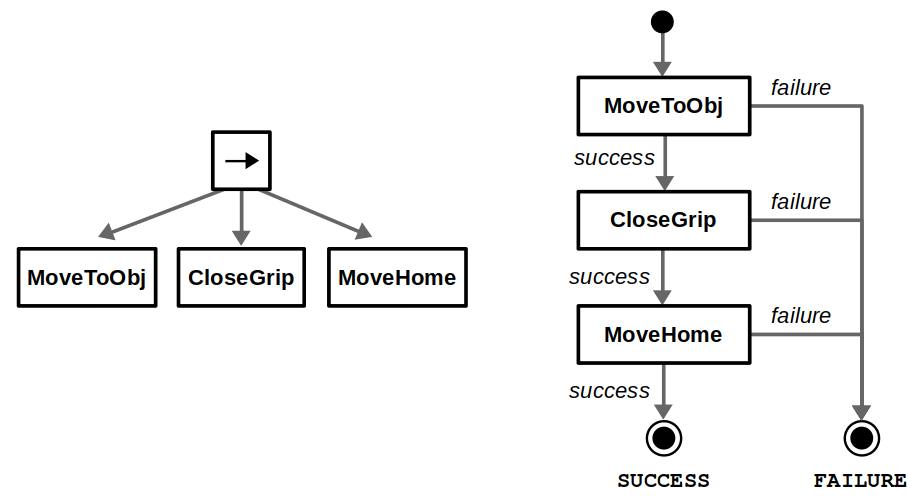
- Starting from the root, nodes are evaluated in order
- Each node returns a status: Success, Failure, or Running
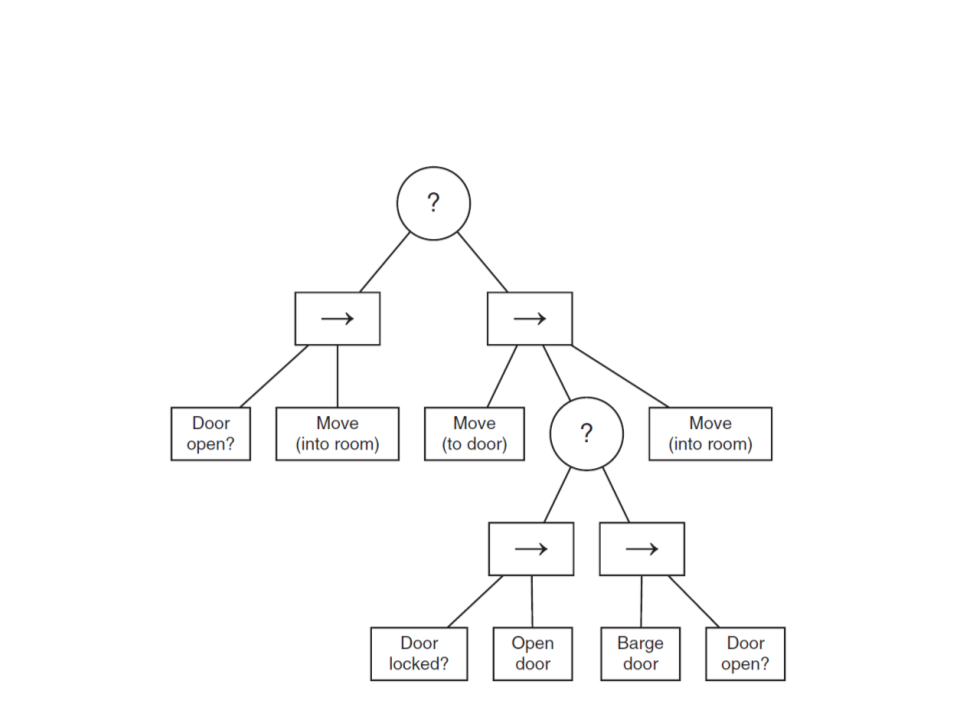
- Control flow is determined by composite nodes (Sequence, Selector, Parallel)
- Core Node Types:
- Sequence: Executes children in order until one fails (all must succeed)
- Selector: Executes children in order until one succeeds (at least one must succeed)
- Parallel: Executes multiple children simultaneously
- Decorators: Modify the behavior of child nodes (invert, repeat, etc.)
- Actions/Conditions: Leaf nodes that perform actual work or check conditions
- Execution Flow:
- The tree is ticked from the root
- Status propagates up the tree based on node semantics
- Running nodes maintain state between ticks
- The tree can be interrupted and resumed based on conditions
- Control Flow + Policy: Unlike pure control structures, BTs encode both the decision logic (control flow) and the policy (what actions to take) in a single structure
Examples
Game AI
- NPCs in games use BTs to determine behaviors like:
- Patrol routes (Sequence of waypoints)
- Combat decisions (Selector between attack, defend, retreat)
- Complex behaviors combining movement, combat, and interaction
Robotics
- Robot control architectures use BTs for:
- Task decomposition (breaking complex tasks into simpler actions)
- Safety-critical behaviors (ensuring deterministic responses)
- Explainable autonomy (humans can understand and verify robot decisions)
Modern AI Systems
- BT + RL Hybrids: Behavior trees provide high-level structure while reinforcement learning optimizes low-level actions
- BT Compilation from Planners: Automated planners generate behavior trees for execution
- Formal Verification: BTs can be formally verified for safety properties
- Runtime BT Synthesis: Systems that generate or modify BTs at runtime based on conditions
- The Bonsai project provides a Rust-native, strongly typed implementation
- Demonstrates BTs' suitability for:
- Embedded systems
- Robotics applications
- Game engines
- Deterministic execution with concurrency-aware semantics
Misconceptions
- Behavior trees are only for games → False. BTs are widely used in robotics, autonomous systems, and modern AI architectures
- BTs are just fancy state machines → False. While related, BTs offer hierarchical composition, better readability, and different execution semantics
- BTs are outdated compared to neural networks → False. BTs are actively used alongside and in combination with modern AI techniques like RL
- BTs can only express simple behaviors → False. Through composition, BTs can express very complex behaviors while remaining maintainable
- BTs are always deterministic → True, but context matters. BTs themselves are deterministic, but they can interact with non-deterministic systems (like RL policies)
- BTs replace all other AI techniques → False. BTs are often used as high-level controllers that coordinate with other AI systems
Related